


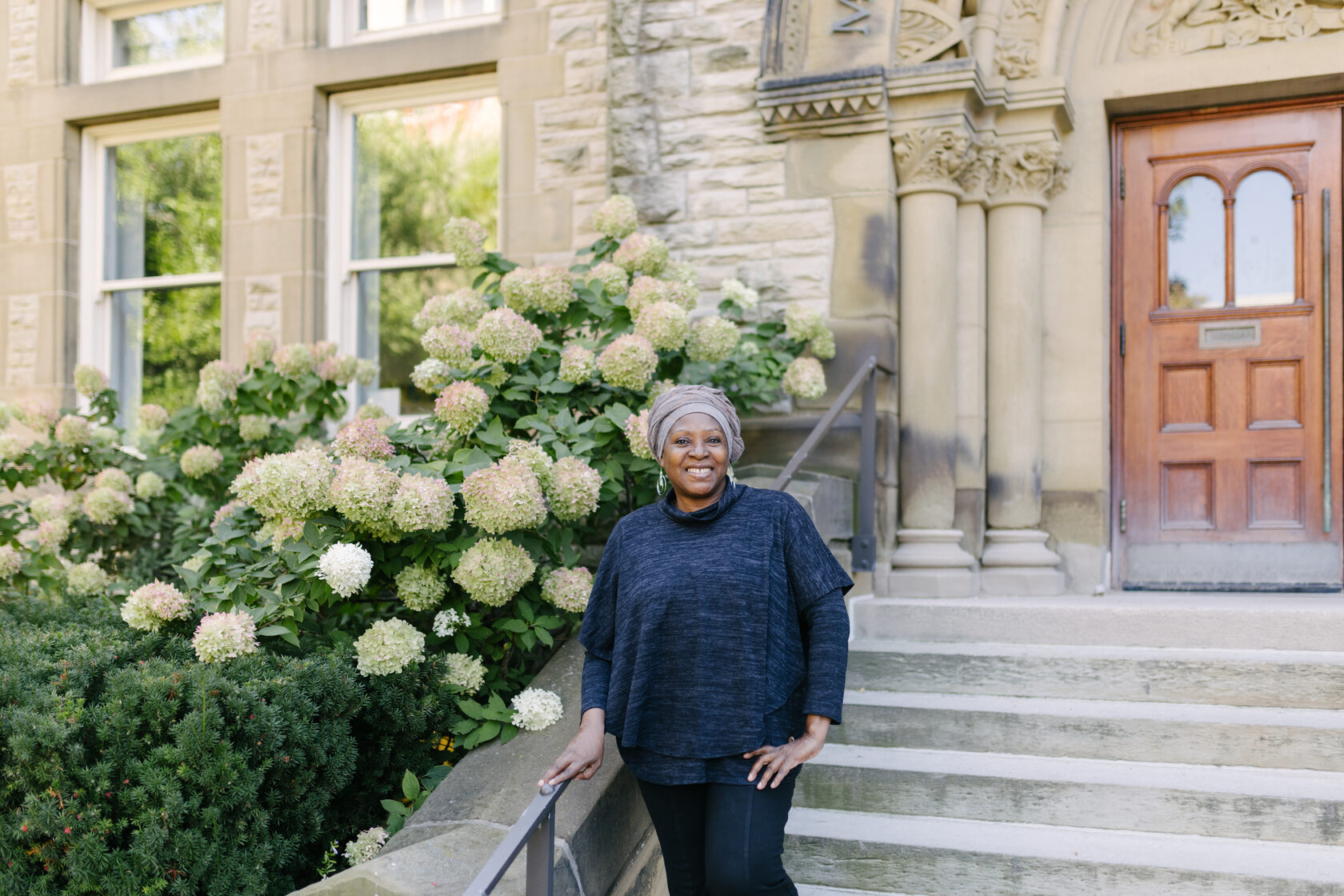
At this stage, familiar walls of the Munk School of Global Affairs and Public Policy met me once again to interview Dr Afua Cooper. My acquaintance with her work began with the book “The Hanging of Angélique”, a dramatic non-fiction that sheds light on the often disregarded history of slavery in Canada through the story of Marie-Joseph Angélique, an enslaved woman, who was convicted of setting the fire that destroyed forty-six buildings in Montréal. The heartbreaking, yet empowering story of the main heroine who asserts her own voice throughout the book had a memorable effect on me, revealing the strength that can emerge from suffering and the profound resilience required to reclaim one's humanity and dignity in the face of oppression. Hence, I was thrilled to hear from the author herself, who must be commended for paying the ultimate tribute to Marie-Joseph Angélique by committing over 15 years to researching and bringing her story to life, on her journey, establishing her own strong identity and lifelong fight against institutional discrimination.
Dr Cooper, whose achievements and awards are hard to fit on a page, is, in many ways, a pioneer who sheds light on the history of Black people in Canada and the African Diaspora.
Her indomitable research on slavery, abolition, freedom, Black education, and women's studies across Canada has made her one of the leading figures in African Canadian studies. In terms of her teaching career, Dr Cooper is currently a faculty member in the Department of Historical and Cultural Studies at the University of Toronto Scarborough, where she teaches courses on Black Studies and Black Canadian history. Before joining U of T, she served as a Killam Research Chair at Dalhousie University, where she established both the Black Studies program and the Black Canadian Studies Association. Her aims are largely inspiring for future specialists in the field, as the primary impulse behind her multidisciplinary work is to change Canadian consciousness about slavery and to bridge the gap between academia and the world.
In this interview, Dr Cooper shares her thoughts on social justice, fostering multidisciplinary approaches to history and academia, and on inspiration and identity formation within competitive, often undervalued fields such as writing and poetry.

As your work spans across history, poetry and social justice, could you share how your academic journey evolved to encompass these different areas of focus and how it all started for you?
I would say my path in social justice began prior to my academic journey. I was born into a political household, with both of my parents never being indifferent to social issues. They always displayed active interest in making our homeland a better place, vigorously advocating for broad access to running water, education, public health, and investments in public goods such as infrastructure: roads, bridges, and housing. Hence, social justice was tightly incorporated into my daily life. For me, it always meant "the effort to have, for people to have a better life". Therefore, I never perceived academia, which is often very detached from the general public, as an ivory tower.
Nonetheless, when I resumed my Master's and PhD, it was automatically expected that I would pursue an academic career, which I did. At the time, at the University of Toronto, where I completed my PhD, the interest in social activism was often looked down upon by both students and professors. The aforementioned academia's ivory tower and the idea that if you're a pure scholar, then you should be ensconced in that same tower and not be touched by what's happening in the "real life" was paradoxical and fascinating to me, as we are all citizens of the world, a positive contribution to which is an integral part of who I am. I have never seen my life as a scholar or researcher divorced from the real world. Hence, from the very beginning of my higher education, I was involved in activism. For example, as an undergraduate student, I was part of the anti-apartheid movement, involved in my university divesting from holdings that supported the apartheid movement in South Africa. It was the bones of life, the blood of life out there.
Would you say there is one area of your academic interest that has special importance informing you as an academic, as a person, or as a writer?
That area would be slavery. More specifically, the transatlantic slave trade and the institution of slavery itself, both within Canada and across North America. Most of my work seems to revisit that subject, as studying it is a lifelong passion, and I don't think that's an accident.
For me, studying slavery is a way of making sense of the world, of understanding what happened to Black people in this part of the diaspora. It's also personal. My own family, my ancestors, lived in Jamaica and came from different parts of Africa. The trauma of that history is something I carry, even unconsciously.
You know, here I am speaking to you in English — and I'm not English. Why am I speaking English? Or, for others, it might be French or Portuguese. The only reason we speak these languages is because a great wrong happened somewhere down the line — a massive wrong inflicted on our ancestors. It's a wrong so deep, so psychological, so all-encompassing, that it can never truly be repaid.
So my work on slavery is an attempt to make sense of that — to understand it, to confront it, and to think about how we move forward as a society and as a human species!
What is one project or publication that you are most proud about?
I am pleased and proud of my last book, The Halifax Explosion, which covers the events of 6 December 1917 when two ships carrying munitions and war supplies collided in the Halifax Harbour. I am also eternally proud of The Hanging of Angélique because I think it's a meaningful piece of work, and out of anything that I've done, it probably stretched me the most as a writer.
Are there any authors that helped you to shape your writing style, someone you look up to in terms of their writing?
The first author that comes to mind is a Caribbean poet and historian called Kamau Brathwaite. I rely on him for possibilities; he shows how to pursue different disciplines simultaneously successfully.
There are a few others- Walter Rodney influenced me as a historian, Toni Morrison as a novelist, and Umberto Eco as a multidisciplinary scholar.
What are your top three book recommendations on Black history?
Well, it's really broad. It's really a big field, right? And we are looking globally. There's so much around the world.
It is a vast field, especially when we look globally. However, I would blow my own trumpet and say to read my book — "The Hanging of Angélique: The Untold Story of Slavery in Canada and the Burning of Old Montréal" — because it allows for an in-depth journey into the African diaspora, the transatlantic slave trade, and how that manifested itself in Canada during the French colonial era in New France.
Another one would be Cheikh Anta Diop's — the Senegalese historian and polymath — "The African Origin of Civilisation". This book makes me return to it repeatedly.
Number three —Walter Rodney's How Europe Underdeveloped Africa.
When you’re writing, do elements of your own identity or experiences find their way into your characters?
It really depends on what I'm writing, because I work in many genres. If it's historical fiction — well, yes, in a sense. But do I actually see myself in the characters? Not really. Sometimes it's more about context. A character might exist in a place I know — say, rural Jamaica, where I was born. Even though I've never lived in the eighteenth century, I understand that landscape. I can imagine the mountain, the flora, the river, and the waterfall over there plunging, which creates a kind of psychological intimacy between me and my characters. I know what the character is thinking as they walk through that space, because I've been there.
But otherwise, no — the characters are authentic creations. They have their own independent lives. Sometimes they even surprise me. I'll write something and think, "Wait, why is this person doing that?" And then I realise — it's because that person isn't me.
Part of why I enjoy writing in different genres is that each one allows me to experience something different.. Some historians, like Natalie Zemon Davis in Women on the Margins, insert themselves into the story. I find that disconcerting. If you want to imagine, it's better to write a novel!
When I began researching Marie-Joseph Angélique — who became the subject of The Hanging of Angélique — I actually started writing it as a novel. I was inventing details, and it just didn't feel right. This was a real woman, a historical figure. So I stopped and decided: no, this needs to be a history, a biography.
Poetry is a happy medium. You can do fiction and non-fiction — you can do anything in poetry. That's why I love it. It's freeing.
What advice would you give to young writers just beginning to develop their career?
My advice would be to be consistent. Even if you don't write every day, write frequently! Because the more you write, the more natural it will become to you. I even have days when I am not satisfied with my writing, and it looks like complete nonsense. You're just plodding along until eventually clarity kicks in.
Also, surround yourself with writers, attend creative writing workshops and meetings, which I used to detest, but I don't anymore. They build a community. Although many writers prefer to work alone, I can't stress enough the importance of forming a network and making contacts. For instance, you can join the Writers Union of Canada, where membership costs around $30 a year, which may be something you can afford as a student.
Moreover, take a writing course if you can, as I've just completed my Master of Fine Arts Degree at the University of King's College in Halifax. I have to say, it was wild, because when I started the program two years ago, I thought to myself, "Why am I in this program? I've written 13 books". The program itself was very hard due to its high intensity and fast pace. However, I found it very meaningful because I was exposed to literature that I usually wouldn't read, such as science fiction and horror. I cannot emphasise enough how important it is to continue studying as part of your development as a writer. I've taken numerous writing and poetry courses over the decades, and each one has immensely contributed to my style, writing skills, and teaching abilities.
The fourth would be to keep reading. If you don't have money to buy the books, get a library card. The library is a really great place. They have everything!
What direction do you see your writing career taking in the future?
I'm currently working on a novel for my MFA project. The story is set in the late 18th century. It tells a tale of two enslaved young people from Africa who ended up in Jamaican slavery. They fall in love, and they must make meaning of their lives in enslavement. The working title is "The Children of Nago". Nago was one of the Yoruba nations in what is now Nigeria.
Another publication is a history text in a collection of essays on various aspects of enslavement in Canada written by different authors. I will have a chapter there. I'm the overall editor, but it's other authors who are submitting their chapters.
What initially drew you to teaching?
My early teaching experiences were enriching. One of the first courses I taught as a sessional instructor at my university was Black Feminist History. It was an exciting opportunity because I was able to design the curriculum from the ground up, engage with a range of powerful readings, and bring together materials that reflected my academic and personal passions.
Another early course I developed was African Canadian History, which was equally fulfilling for the same reasons — the freedom to curate content and guide students through narratives that had long been overlooked.
I often describe teaching as "fun," though it certainly demands effort and focus. It's intellectually rigorous work, but I genuinely enjoy it. I love studying, discovering new materials, and sharing the obtained knowledge with others. So while the work is intense, I don't see it as difficult — it's deeply engaging and meaningful to me.
Were there particular books, courses, or professors during your studies that inspired your focus on Black history and women’s studies?
Not necessarily. I started my academic journey fully aware of what I wanted to do: African history for my PhD studies, and I did end up doing that. But I also majored in Canadian history and later pursued Black Canadian history as an academic discipline.
As I became a university student, I wasn't a tabula rasa; I came in with knowledge of history and a culturally rich background, with a strong academic base from my parents and other mentors. However, as most of my professors were white men, there was this idea that as a Black woman, you should know your place and you shouldn't ask too many questions. That motivated me to find my journey through university challenging.
However, I had a professor named Frederick Case, who has since passed away. He was a professor of French, French literature, and Black Francophone literature. His influence was not on my areas of specialisation, but on my perception of work and academia —taking work seriously and demonstrating excellence. He was my inspiration to become an excellent scholar and researcher.
My heart was set on challenging the entrenched ideas about African history that were not only proved incorrect but also undermined the discipline from within. For example, many of these white European scholars or North American scholars actually do a great injustice to Black people because they have cut Egypt off from Africa. They have whitened that civilisation —the civilisation of ancient history. I started my African history journey by entering a department called Near Eastern Studies, which specialises in states from Africa such as Egypt and Libya and was forcefully defined as the study of the Near East. I had endless arguments with these professors in Near Eastern Studies until I realised how politicised academia is. I just quit the so-called Near Eastern Studies. Then I went into "Sub-Saharan African history", which was a struggle in itself, as I saw the way pedagogy was slanted to suit a particular agenda. Learning is political. History is political. Unfortunately, there's nothing neutral about it. Hence, there were points in my journey, such as during my doctoral studies, when I felt like quitting. I thought my only option was to leave, as I couldn't remain quiet and passive. So I had to come up with a third way —a way of being —so I could pass the course or, you know, be successful in the program and still maintain my dignity.
I should also mention another professor, Allison Prentice, who has passed away. She supervised my Master's thesis on Black teachers in the province of Ontario, Canada, during the 19th century. Although she wasn't well-versed in my particular area, she was curious and very supportive, realising how shortchanged Black history in Canada has been. So I'm very grateful to her, you know, for believing in me and supporting me when there wasn't much support along the way.
Have your personal experiences as a Black woman impacted your philosophy and style as an educator?
I would say that my identity, my location, my subjectivity — these are the significant factors that offer me, hence my curriculum, a unique perspective. Moreover, because Black women, in any sphere of life — whether as an academic, a businessperson, a secretary, or a CEO — are not seen as people with authority, I often have to take steps to make my authority clearer.
Some of my students, predominantly white male students, question my position based on the way I look, almost examining me on topics I teach. At the beginning, it was a struggle, yet I'm not going to base my everyday life on proving my knowledge and right to my current position. What matters is my confidence in my position and my passion towards my areas of specialisation!
Could you share your experiences of teaching at Dalhousie University and University of Toronto? What would you say has been the most memorable experience? And how are these institutions different?
Like I said, education is political. Hence, I do not see the universities in Canada or anywhere else as trailblazers — institutions that are there to empower students and take their learning seriously — because it has become a marketplace.
I don't have any rosy feelings about university institutions anymore, compared to when I was an undergraduate student. Then the issues were a little different in terms of social justice, but sometimes the institutions' responses were the same: students were consistently put in situations where they were expelled, and professors were arrested.
However, what I always found to be special at Dalhousie is that I pioneered the Black Studies program. There are now minor, major, and Bachelor of Arts programs in Black Studies. For me, the opportunities to build infrastructure at educational institutions are of great significance because of the positive footprint they leave. A chance to benefit generations of students, providing them with the ability to engage in Black Studies or Black history — that's what matters the most to me.
So teaching a course at UofT is terrific, but establishing infrastructure to ensure these branches of knowledge endure longer is even more powerful.
How would you define the mission of Black Studies today?
I'm not sure there's a clear definition — at least not in Canada. Unlike in the United States, where Black Studies had been established for the last sixty years and began deteriorating with history itself being erased — you can't teach slavery, you can't teach about Harriet Tubman, which, somehow, is considered a crime- in Canada, we're just beginning. It's still very much a work in progress. We'll have to see how it develops, especially as universities start retreating from their commitments to EDI — equity, diversity, and inclusion. You hear a lot of institutions saying, "That moment has passed. Let's get back to business as usual."
And "business as usual," of course, means Eurocentric education. Yet, at the same time, we're also seeing the early stages of Black Studies taking root in Canadian universities. So this tension has to be resolved — progress and pullback happening simultaneously. That contradiction is precisely what worries me: although we're finally beginning to build this field, some universities seem ready to pull the plug on their EDI commitments!
What are your future plans or aspirations when it comes to your career in teaching?
Since this September, I have been teaching a course on slavery (HISB43H3), which examines the experiences of enslaved Black people in New France and the five early Canadian colonies—Prince Edward Island, New Brunswick, Nova Scotia, Quebec, and Ontario, as well as the connections between the systems of slavery in Canada, the United States, and the Caribbean. Then from January to April, I'll be teaching a course on black feminist history (HISB22H3), which explores the histories of Black radical women's actions and ideas in Canada, tracing the lives and political thought of Black women and gender-non-conforming people who resisted and escaped enslavement. We are going to look at individual and collective struggles against racial segregation in labour, education, and immigration—offering a historical foundation for today's queer-led #BlackLivesMatter movement. And then, in the summer of 2026, I'm doing a course on the slave narrative, looking at narratives outside the dominant European and North American context.
Photos: Victoria Zaitseva
